

Every day, millions of people earn money online without ever manufacturing a product, handling customer support, or managing inventory. They do it by simply recommending things they already believe in, and getting paid when someone buys.
That’s affiliate marketing in its purest form, and it’s one of the most accessible business models the internet has ever produced.
No matter if you stumbled across an influencer’s “link in bio,” clicked a “best laptops for students” article, or noticed a YouTube creator mention a discount code, you’ve already been on the receiving end of affiliate marketing.
Now it’s time to understand how the engine behind it actually works, and how you can become a part of it. This complete guide covers everything from the basic definition to advanced strategies, commission models, real examples, pros and cons, and exactly how to get started, even if you’re beginning from absolute zero.
What is Affiliate Marketing? (The Core Definition)
Affiliate marketing is a performance-based marketing model where an individual or business — called an affiliate or publisher — earns a commission by promoting another company’s products or services through a unique tracking link.
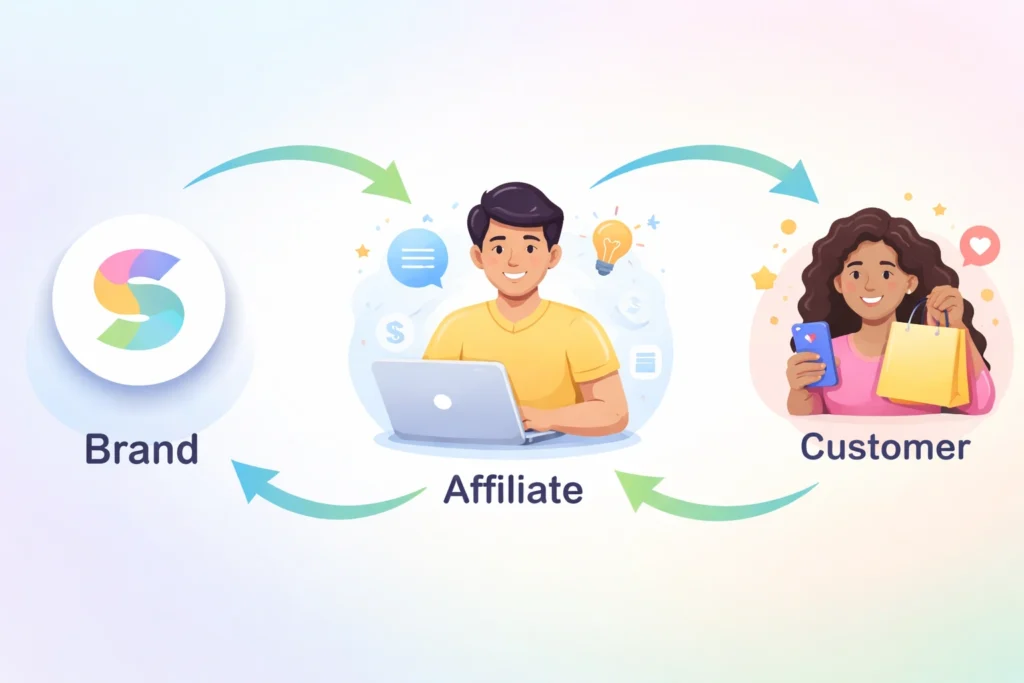
When someone clicks that link and completes a desired action (usually a purchase, but sometimes a sign-up or free trial), the affiliate earns a pre-agreed commission. The brand pays only for real results, like conversions and leads, not for impressions or clicks alone.
That’s what makes it genuinely different from traditional advertising. Think of it like a referral bonus program at scale. You recommend a product to your audience. They buy it. You earn a cut. The brand gets a new customer. Means it’s a win-win situation.
The global affiliate marketing industry is valued at 18 billion dollars and continues to grow year on year, which is driven by the expanding creator economy, the proliferation of niche content platforms, and increasingly sophisticated tracking technology.
How Affiliate Marketing Works: Step by Step
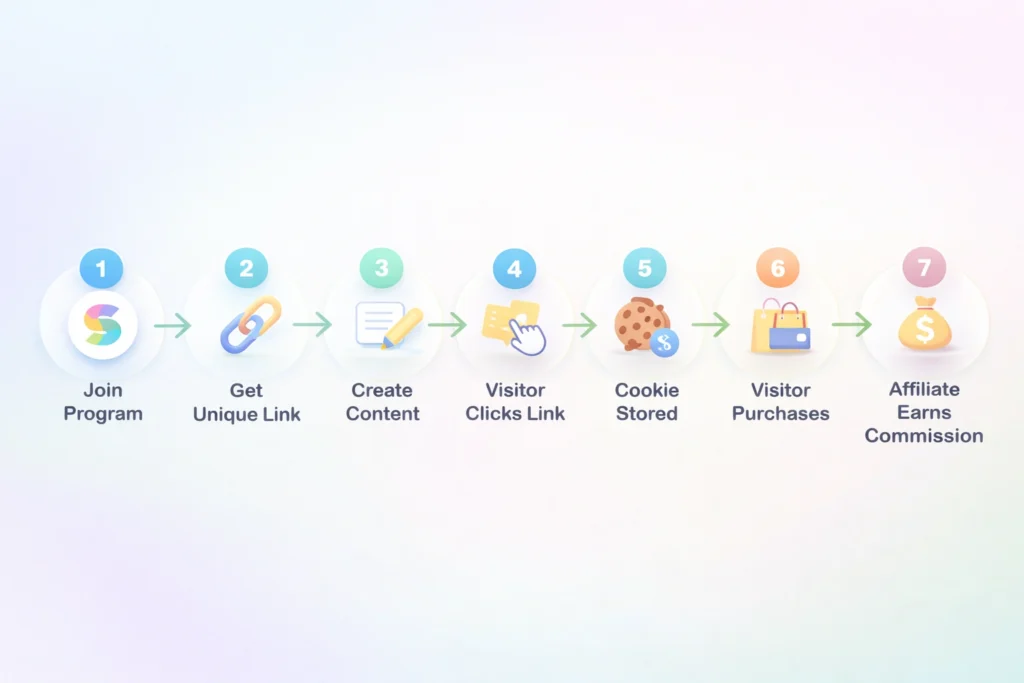
Understanding the mechanics is critical before anything else. Here’s exactly how a single affiliate transaction works from start to finish:
- You join an affiliate program — either directly through a brand’s website or through a third-party affiliate network like Amazon Associates, ShareASale, or Impact.
- You receive a unique tracking link — this URL is coded specifically to you, so every click and sale originating from it is attributed to your account.
- You create content that features a link — a blog post, YouTube video, Instagram story, email newsletter, or social media post.
- A visitor clicks your link — their browser stores a small file called a “cookie” that records your referral. Cookie duration determines how long this window stays open (typically 24 hours to 90 days, depending on the program).
- The visitor completes the desired action — a purchase, a sign-up, or a form submission.
- The affiliate network or brand tracks the conversion — the sale is verified and credited to your account.
- You earn your commission — paid out on a schedule (weekly, bi-weekly, or monthly) via PayPal, bank transfer, or check.
The Four Core Parties in Affiliate Marketing
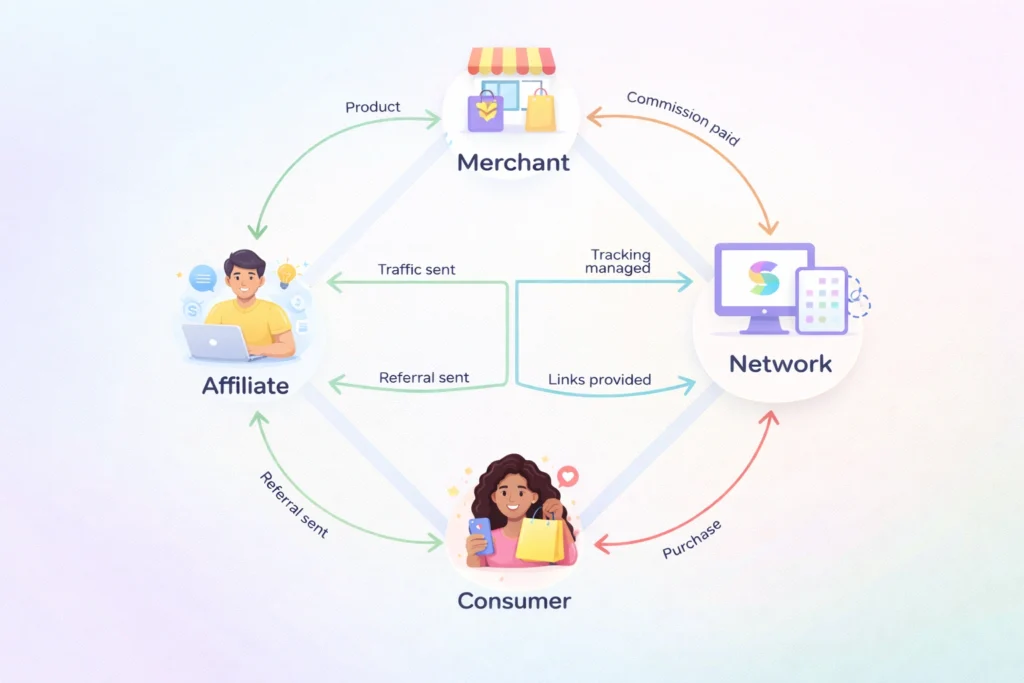
Every affiliate transaction involves four key players. Understanding each role clarifies how the system functions as a whole.
1. The Merchant (Advertiser / Brand)
The company that owns the product or service being promoted. They create the affiliate program, set commission rates, and supply affiliates with promotional materials. Examples: Amazon, Shopify, Bluehost, NordVPN.
2. The Affiliate (Publisher / Creator)
The individual or organization doing the promotion. This could be a solo blogger, a YouTube creator, a comparison website, a coupon platform, or even a large media company. The affiliate’s job is to connect the right audience with the right offer in a way that feels natural and helpful.
3. The Affiliate Network (or In-House Program)
An intermediary platform that tracks referrals, manages payments, and provides reporting dashboards. Popular networks include Amazon Associates, CJ Affiliate, Rakuten, ShareASale, Impact, and PartnerStack. Some brands bypass networks entirely and run their own in-house affiliate programs.
4. The Consumer (End User)
The person who ultimately clicks the link and takes the desired action. The consumer doesn’t pay extra because of affiliate tracking, and the price remains the same regardless of whether a referral link was used.
Types of Affiliate Marketing (By Relationship)
Not all affiliates promote products the same way. Marketing expert Pat Flynn famously categorized affiliate marketing into three distinct types based on the affiliate’s relationship to the product:
1. Unattached Affiliate Marketing
The affiliate has no personal connection to the product and creates no content around it. They rely on paid advertising (like Google Ads or Facebook Ads) to drive traffic directly to an offer. It’s fast but risky — and requires real ad spend expertise to be profitable.
2. Related Affiliate Marketing
The affiliate has an audience in a relevant niche but doesn’t personally use the product. For example, a travel blogger recommending luggage they haven’t personally tested. There’s some authority, but less authenticity.
3. Involved Affiliate Marketing
This is the gold standard. The affiliate has personally used the product, can speak to its benefits and drawbacks from first-hand experience, and integrates recommendations naturally into their content. This type builds the most trust and drives the highest conversions in the long term.
In 2026, Google’s E-E-A-T framework (Experience, Expertise, Authoritativeness, and Trustworthiness) places heavy weight on first-hand experience in affiliate content. Involved affiliate marketing isn’t just an ethical best practice — it’s an SEO advantage.
Affiliate Commission Models: How Do Affiliates Get Paid?
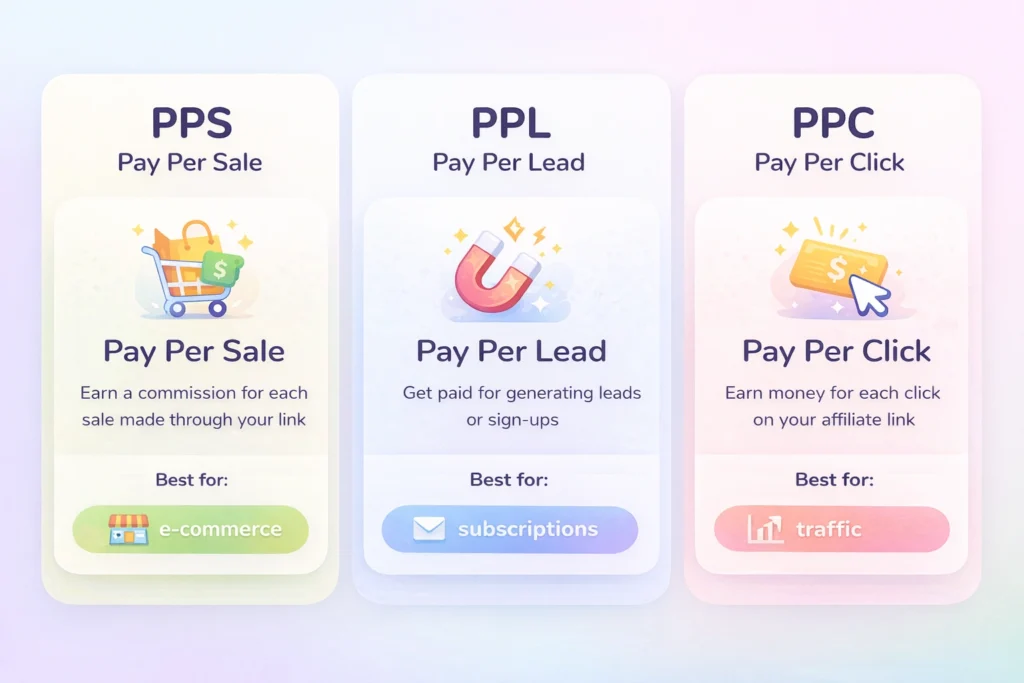
One of the most important things to understand is how you actually earn. There are several payout models, and different programs use different ones:
| Commission Model | How It Works | Best For |
|---|---|---|
| Pay-Per-Sale (PPS) | Earn a percentage of each completed purchase | Physical and digital products |
| Pay-Per-Lead (PPL) | Earn for generating qualified leads (sign-ups, form fills) | SaaS, financial services, insurance |
| Pay-Per-Click (PPC) | Earn for every click on your link, regardless of purchase | High-traffic content sites |
| Pay-Per-Install (PPI) | Earn when a user installs an app or software | Mobile and software companies |
| Recurring Commissions | Earn ongoing commissions for subscription products | SaaS, membership sites |
| Two-Tier Commissions | Earn from affiliates you refer to the program | Multi-level affiliate networks |
Recurring commissions are particularly powerful for long-term income — when you refer someone to a subscription service, you keep earning every month they remain a customer.
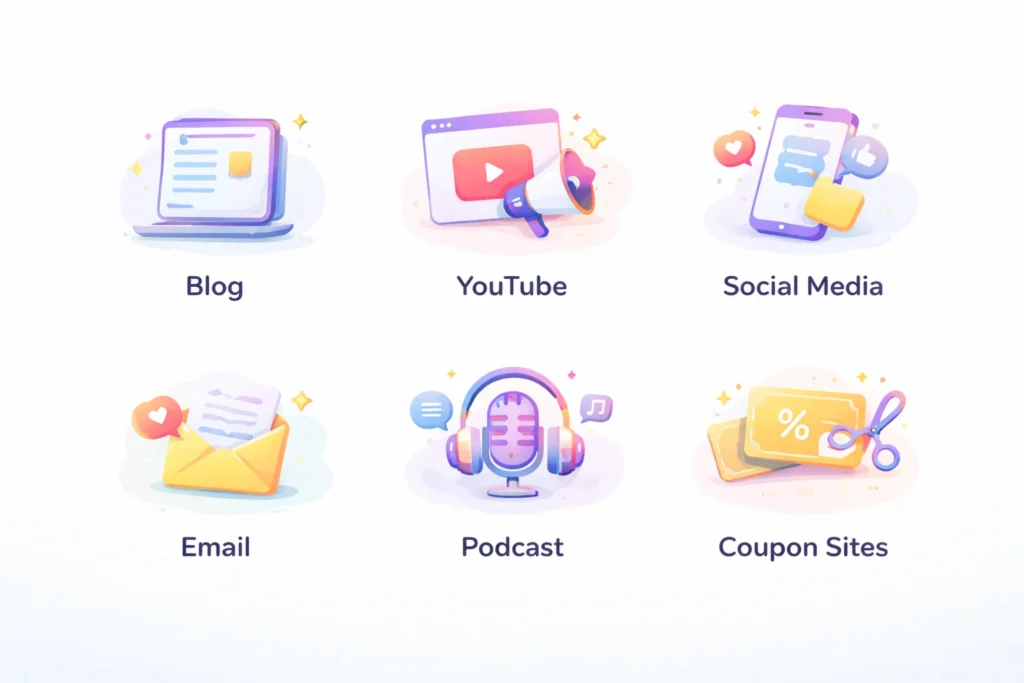
6 Most Popular Affiliate Marketing Channels
Where you promote your affiliate links matters as much as what you promote. The best channel depends on your audience, skills, and content style.
1. Blogging / Content Websites
Long-form content like product reviews, buying guides, tutorials, and comparison articles remains the most durable affiliate channel. Blog posts can rank on Google for years, generating passive income long after publication. This is why SEO is the backbone of most affiliate strategies.
2. YouTube
Video reviews and tutorials convert extremely well because viewers can see a product in action. The affiliate link typically lives in the video description. YouTube SEO follows similar principles to Google SEO; alongside keyword research, titles, thumbnails, and watch time all matter.
3. Social Media (Instagram, TikTok, Pinterest)
Ideal for lifestyle, fashion, beauty, and consumer products. TikTok Shop’s affiliate program has become particularly powerful for short-form video content, while Pinterest drives strong traffic for home, food, and DIY niches. Further, influencers also make money through affiliate marketing campaigns.
4. Email Marketing
An owned channel with zero algorithm risk. A well-segmented email list with strong open rates can generate significant affiliate revenue through newsletters, curated product recommendations, and promotional sequences.
5. Podcasts
Podcast hosts regularly mention promo codes and affiliate links for brand partners. The intimacy of the medium builds deep listener trust, which drives strong conversion rates.
6. Coupon and Deal Sites
Sites like RetailMeNot and Honey aggregate discount codes across thousands of brands and drive high-purchase-intent traffic. These operate as affiliates at scale.
Affiliate Marketing vs. Other Marketing Models
People often confuse affiliate marketing with similar concepts. Here’s how it compares:
- Affiliate Marketing vs. Influencer Marketing. Influencer marketing typically involves a one-time flat fee paid to a creator for exposure, regardless of results. Affiliate marketing is purely performance-based; the creator earns only when a conversion happens. Many influencers now combine both: they take a flat fee and earn affiliate commissions.
- Affiliate Marketing vs. Referral Marketing. Referral programs are usually customer-to-customer (e.g., “refer a friend, get $10 off”). Affiliate marketing is business-to-publisher — a formal commercial relationship between a brand and a content creator or media partner.
- Affiliate Marketing vs. Dropshipping. Dropshipping requires you to run an online store, manage orders, and handle customer relationships (even if the brand ships the product). Affiliate marketing requires none of that — you simply drive traffic and earn commissions.
Advantages of Affiliate Marketing
For Affiliates (Publishers):
- Low barrier to entry — No product creation, no inventory, no customer service
- Passive income potential — Content created once can generate commissions for months or years
- Flexibility — Work from anywhere, in any niche, on your own schedule
- Scalability — Add more content, more programs, more platforms without a hard ceiling
- No financial risk — You don’t invest in products that may not sell
For Merchants (Brands):
- Performance-based cost — Pay only for actual sales or leads, not for exposure
- Expanded reach — Tap into audiences you couldn’t build yourself
- Cost-efficient acquisition — Affiliate commissions are often cheaper than paid ads at scale
- Brand credibility — Third-party recommendations from trusted creators carry more weight than brand-owned advertising
Disadvantages and Challenges of Affiliate Marketing
Honesty matters here. Affiliate marketing is not a passive income overnight machine. Real challenges include:
- It takes time — Building an audience or ranking on Google takes months, sometimes a year or more, before meaningful income arrives
- Income instability — Algorithm changes (Google, Instagram, YouTube) can devastate traffic overnight
- Commission rate control — Brands set the rates. Amazon famously slashed its commission rates in 2020, cutting affiliate income across the board
- High competition — Popular niches (finance, health, software) are saturated with established players
- Dependence on the brand’s program — If a brand closes its affiliate program, your income from it disappears
- Disclosure requirements — FTC guidelines (and equivalent regulations globally) require clear, conspicuous disclosure of affiliate relationships. Non-compliance carries real legal risk
How Much Money Can You Actually Make?
This is the question everyone asks, and the honest answer is: it varies enormously.
- Beginners — Most new affiliates earn their first $100–$500 within three to six months if they publish consistently
- Intermediate affiliates — With 12–18 months of focused effort, $1,000–$5,000/month is achievable in competitive niches
- Advanced affiliates — Established affiliate sites generating six to seven figures annually exist, but they represent years of compounding effort and investment
Commission rates themselves range widely:
- Amazon Associates — 1% to 10% depending on product category
- Software / SaaS programs — Often 20%–50% recurring per month
- High-ticket programs — Some financial or education products pay $500–$1,000+ per referral
A realistic expectation: treat affiliate marketing as a long-term business, not a short-term side hustle, and the compounding returns become genuinely life-changing.
How to Start Affiliate Marketing: A Step-by-Step Roadmap
Step 1: Choose Your Niche
The narrower, the better. “Fitness” is too broad. “Home workouts for new moms” or “budget home gym equipment under $200” gives you a clear audience, lower competition, and better content ideas. Pick something at the intersection of your genuine interest and proven market demand.
Step 2: Choose Your Platform
Start with one channel and master it before expanding:
- Blog — Best for long-term SEO and passive income
- YouTube — Best for product demos and tutorials
- TikTok/Instagram — Best for lifestyle and consumer products
- Email newsletter — Best for high-engagement direct audiences
Step 3: Find Affiliate Programs
Start with programs that match your niche and audience:
- Amazon Associates — Massive product range, low commissions
- ShareASale / CJ Affiliate / Impact — Broad networks with thousands of brands
- PartnerStack — Software and SaaS programs
- Brand-specific programs — Many companies run their own (Shopify, Bluehost, SEMrush, etc.)
Step 4: Create Genuinely Helpful Content
Affiliate content that converts solves real problems. Focus on:
- In-depth product reviews with real experience
- Comparison articles (“X vs. Y: Which Is Better?”)
- Best-of roundups (“10 Best Tools for Freelancers”)
- How-to tutorials that naturally feature affiliate products as solutions
Step 5: Drive Traffic
SEO (search engine optimization) is the most sustainable long-term traffic source for affiliate marketers. Combine it with social media distribution and email list building to reduce dependence on any single channel.
Step 6: Disclose Your Affiliate Relationships
Always. Every time. A simple statement like “This article contains affiliate links. If you click and purchase, I may earn a commission at no extra cost to you” is legally required in most countries and builds audience trust in the long run.
Step 7: Track, Analyze, and Optimize
Use your affiliate dashboard’s reporting tools to identify which content, links, and products convert best. Double down on what works, prune what doesn’t.
Affiliate Marketing Trends to Watch in 2026
The landscape evolves constantly. Here’s what’s defining affiliate marketing right now:
- Creator-led commerce — Micro and nano-influencers with highly engaged niche audiences are outperforming macro-influencers in conversion rates. Authenticity beats reach.
- AI as a workflow tool — Affiliates are using AI tools for content ideation, outline creation, and drafting. However, Google’s quality algorithms reward genuine first-hand experience, which AI alone cannot replicate.
- Recurring and subscription commissions — As SaaS and subscription businesses grow, recurring affiliate programs are becoming more attractive for building a stable monthly income.
- Transparency and compliance — Audiences and regulators increasingly demand clear affiliate disclosures. Building honesty into your brand from day one is both an ethical and strategic advantage.
- Multi-platform diversification — Top affiliates in 2026 don’t rely on a single traffic source. They build SEO-driven blogs, YouTube channels, email lists, and social presence simultaneously to de-risk algorithm dependency.
Real-World Affiliate Marketing Examples
Example 1: The Tech Review Blog, a blogger writes an in-depth comparison of the best web hosting services. The article ranks #2 on Google for “best web hosting for small business.” Every reader who clicks the Bluehost link and signs up earns the blogger a $65–$130 commission. With 10,000 monthly readers and a 2% conversion rate, that’s 200 commissions — a five-figure monthly return from a single article.
Example 2: The YouTube Creator, a personal finance YouTuber, creates a video titled “How I Invest My Money in 2026.” They mention a brokerage platform in the video description with an affiliate link. The video gets 500,000 views over its lifetime. Even a 0.5% click-to-sign-up conversion generates thousands of qualified leads.
Example 3: The Email Newsletter, a productivity newsletter with 25,000 subscribers, recommends a project management tool in its weekly issue. With a 35% open rate and a 5% click-through, 437 people visit the tool’s sign-up page. Even a 10% conversion rate means 43 new paying customers referred, generating recurring commissions every month, as long as those users stay subscribed.
Is Affiliate Marketing Worth It in 2026?
Absolutely, yes. But only if you approach it like a real business.
Affiliate marketing is not passive income from day one. It requires consistent content creation, SEO knowledge, audience building, and patience. The first six to twelve months are typically the hardest: little traffic, little income, and a lot of learning.
But the compounding nature of affiliate marketing is what makes it uniquely powerful. A well-written article, a high-ranking YouTube video, or a growing email list can generate commissions for years with minimal ongoing maintenance. The effort you invest today keeps paying you back long into the future.
The opportunity is genuinely strong in 2026. Ad fatigue is real, consumers trust creator recommendations over banner ads, and brands are investing more than ever in performance marketing channels. For anyone willing to commit to building genuine authority and serving their audience first, affiliate marketing remains one of the most accessible and scalable ways to generate income online.
People Also Ask
Q1. Is affiliate marketing free to start?
Yes, in most cases, joining affiliate programs is completely free. Your primary investments are time, a basic website (optional but recommended), and the effort to create consistent content. Some affiliates also invest in SEO tools like Ahrefs or SEMrush to accelerate growth, but these aren’t required to get started.
Q2. How long does it take to make money with affiliate marketing?
Most people make their first commission within one to three months of consistent publishing. Reaching a meaningful income ($500–$2,000/month) typically takes six to eighteen months, depending on niche, content quality, and SEO strategy. Treat it like a business investment, not a lottery ticket.
Q3. Do I need a website to do affiliate marketing?
No, you can promote affiliate links through YouTube, TikTok, Instagram, or an email newsletter without a website. However, a website gives you full ownership of your traffic, better SEO longevity, and more flexibility, so most successful affiliates eventually build one.
Q4. What is the cookie duration in affiliate marketing?
Cookie duration is the length of time a referral stays tracked after a user clicks your affiliate link. If a program has a 30-day cookie, the user has 30 days to complete a purchase for you to earn the commission. Amazon’s cookie is just 24 hours; other programs offer 30–90 days or even lifetime cookies.
Q5. Is affiliate marketing the same as MLM (multi-level marketing)?
No. Affiliate marketing is a legitimate, performance-based marketing channel where you earn commissions for driving sales or leads, full stop. MLMs focus on recruiting others into a program and earning from their activity, often with problematic pyramid structures.